
|
||||||
| Home | Publications | Teaching | PhD students | Repository |

|
|

| ||||||
This page lists a selection of the research projects I have been leading or co-leading.
Ongoing projects
-
Experimental-demonstrative project: SkAIGreen – AI-based active control of drones that seek indicator species for grassland biodiversity
Start: Sept 2025 End: Aug 2027 (ongoing)
Participants: Lucian Busoniu, PI; Alexandru Codrean, team member; Catalina Dan, team member; Davian Martinovici, team member; Georgiana Daneliuc, team member.
 Description: To support agricultural practices that reduce biodiversity loss, the EU introduced the Common Agriculture Policy. One support tool comprises result-based agripayment schemes (RBAPS), in which payments are made to farmers if they show the presence of a minimal number of indicator plant species on the targeted parcel, via a manual monitoring procedure. This procedure is inefficient, expensive, difficult to implement by farmers and to verify by the control body. The natural next step to address these shortcomings is to automate species identification. The SkAIGreen project will therefore develop AI and deep-learning based active control of one drone or a drone team to automatically seek RBAPS indicator plant species for the biodiversity of Romanian grasslands. AI and machine learning will play a key role both in species identification and in active drone control to find as many species as quickly as possible; and we will make fundamental advances in active robot control. The novel technology will provide faster, cheaper, and more verifiable monitoring results than the existing human-based procedure; and will be quantitatively validated in a case study in the Angofa region of Romania. The project is funded under the Experimental-Demonstrative call of the Romanian Authority for Scientific Research, via UEFISCDI (project number PN-IV-P7-7.1-PED-2024-0481, contract number 124/2025). It takes place at the Automation Department of the Technical University of Cluj-Napoca, Romania, in collaboration with Adept Transilvania, for a duration of two years and a total budget of about 150 000 EUR.
-
Horizon Europe IA project: SeaClear2.0 - Scalable Full-Cycle Marine Litter Remediation in the Mediterranean: Robotic and Participatory Solutions
Start: January 2023 End: December 2026 (ongoing)
Participants: Lucian Busoniu, partner PI; Levente Tamas, team member; Tassos Natsakis, team member; Mihalis Maer, team member; David Rete, team member.
 Description:
Today's oceans contain roughly 25 million tons of plastic waste. SeaClear2.0 continues our efforts into marine litter search and collection. The project will improve on the existing, SeaClear team of unmanned underwater, surface and aerial vehicles, so that the system is able to search for deeper litter, in darker waters, and then pickup larger litter items. Several fully new robots are being developed: a large grapple for litter pickup, a team of surface collectors, and a smart tender for litter deposition. Methodology and software will also have to be improved, and the project has a significant component of public empowerment and participation. The project budget is about 9 million EUR, cofunded by the EU, and our team belongs to a partnership of 13 institutions, under the coordination of the Delft University of Technology.
Description:
Today's oceans contain roughly 25 million tons of plastic waste. SeaClear2.0 continues our efforts into marine litter search and collection. The project will improve on the existing, SeaClear team of unmanned underwater, surface and aerial vehicles, so that the system is able to search for deeper litter, in darker waters, and then pickup larger litter items. Several fully new robots are being developed: a large grapple for litter pickup, a team of surface collectors, and a smart tender for litter deposition. Methodology and software will also have to be improved, and the project has a significant component of public empowerment and participation. The project budget is about 9 million EUR, cofunded by the EU, and our team belongs to a partnership of 13 institutions, under the coordination of the Delft University of Technology.
-
PNRR DECIDE: AI design of decentralized coopetitive control over networks
Start: July 2023 End: June 2026 (ongoing)
Participants: Constantin Morarescu, PI; Lucian Busoniu, institution contact.
Description: The DECIDE research project will develop a new unified methodology for decentralized coopetitive control of systems interconnected over networks. Coopetitive interconnected systems blend together competition — each system has its individual cost to optimize — with cooperation in order to reach a coherent synchronized behavior. Due to the lack of precise knowledge on the system's dynamics and on the interconnection topology, we will use machine learning techniques from artificial intelligence (AI) to design agile control strategies. The efficiency of the fundamental results obtained during the project will be validated in high-societal-impact case studies including robotics, epidemics control and climate change planning.
Finalized projects (selection)
-
H2020 RIA project: SeaClear - Search, Identification, and Collection of Marine Litter with Autonomous Robots
Start: January 2020 End: December 2023 (ongoing)
Participants: Lucian Busoniu, partner PI; Levente Tamas, team member; Tassos Natsakis, team member; Mihalis Maer, team member; Matthias Rosynski, team member; Bilal Yousuf, team member.
 Description:
Litter disposal and accumulation in the marine environment is one of the fastest growing threats to the world's oceans. Plastic is the most common type of litter found on the seafloor, but the list is long and includes glass, metal, wood and clothing. The EU-funded SeaClear project is developing autonomous robots for underwater littler collection using new debris mapping, classification, and collection systems. Specifically, the project will build a mixed team of unmanned underwater, surface and aerial vehicles to find and collect litter from the seabed. The project plans to use aerial vehicles to study the correlation between surface and underwater litter. The underwater vehicles will be fitted with a combined suction and gripper device for both small and large waste. The project budget is about 5 million EUR, funded by the EU, and our team belongs to a partnership of 8 institutions, under the coordination of the Delft University of Technology.
Description:
Litter disposal and accumulation in the marine environment is one of the fastest growing threats to the world's oceans. Plastic is the most common type of litter found on the seafloor, but the list is long and includes glass, metal, wood and clothing. The EU-funded SeaClear project is developing autonomous robots for underwater littler collection using new debris mapping, classification, and collection systems. Specifically, the project will build a mixed team of unmanned underwater, surface and aerial vehicles to find and collect litter from the seabed. The project plans to use aerial vehicles to study the correlation between surface and underwater litter. The underwater vehicles will be fitted with a combined suction and gripper device for both small and large waste. The project budget is about 5 million EUR, funded by the EU, and our team belongs to a partnership of 8 institutions, under the coordination of the Delft University of Technology.
-
Young Teams project: AIRGUIDE - A Learning Aerial Guide for the Elderly and Disabled
Start: May 2018 End: June 2020
Participants: Lucian Busoniu, PI; Levente Tamas, team member; Alexandru Codrean, team member; Ioana Lal, team member.
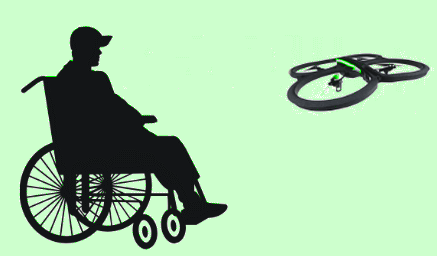 Description: Robotic assistants can greatly improve the life of the ever-increasing elderly and disabled population. AIRGUIDE develops aerial assistive technology for independent mobility of an elderly or disabled person over a wide, outdoor area, via monitoring risks and guiding the person when needed. Our fundamental approach is to develop a novel learning and planning control framework, by exploiting interdisciplinary, artificial-intelligence and control-theoretic insights. The framework is implemented and validated in a case study where an at-risk person is monitored outdoors, warned about risks like falling and unsafe areas, and actively guided to safety or a desired destination when required. The project was funded under the Young Teams program of UEFISCDI, for a total budget of about 100 000 EUR.
-
Young Teams project: Reinforcement learning and planning for large-scale systems
Start: May 2013 End: September 2016
Participants: Lucian Busoniu, principal investigator; Levente Tamas, team member; Elod Pall, team member.
 Description:
Many controlled systems, such as robots in open environments, traffic and energy networks, etc. are large-scale: they have many continuous variables. Such systems may also be nonlinear, stochastic, and impossible to model accurately. Optimistic planning (OP) is a paradigm for general nonlinear and stochastic control, which works when a model is available; reinforcement learning (RL) additionally works model-free, by learning from data. However, existing OP and RL methods cannot handle the number of variables required in large-scale systems. Therefore, this project developed a planning and reinforcement learning framework for large-scale system control. On the OP side, methods were developed to deal with large-scale actions and next states. An approach that accelerates large-scale OP by integrating RL was also designed. The methods were validated theoretically as well as in applications, with an application focus on assistive robotics for mobile manipulation. This project was funded under the Young Teams program of the Romanian Authority for Scientific Research, via UEFISCDI (number PNII-RU-TE-2012-3-0040), for a total budget of 180 000 EUR.
Description:
Many controlled systems, such as robots in open environments, traffic and energy networks, etc. are large-scale: they have many continuous variables. Such systems may also be nonlinear, stochastic, and impossible to model accurately. Optimistic planning (OP) is a paradigm for general nonlinear and stochastic control, which works when a model is available; reinforcement learning (RL) additionally works model-free, by learning from data. However, existing OP and RL methods cannot handle the number of variables required in large-scale systems. Therefore, this project developed a planning and reinforcement learning framework for large-scale system control. On the OP side, methods were developed to deal with large-scale actions and next states. An approach that accelerates large-scale OP by integrating RL was also designed. The methods were validated theoretically as well as in applications, with an application focus on assistive robotics for mobile manipulation. This project was funded under the Young Teams program of the Romanian Authority for Scientific Research, via UEFISCDI (number PNII-RU-TE-2012-3-0040), for a total budget of 180 000 EUR.